One-to-one tutoring can be rewarding, flexible, and highly personalized. It can also put a firm limit on how much income fits into a week, because every additional payment usually requires another hour of live teaching.
The back-to-school period in August and September is an ideal time to rethink that model. Families are setting academic goals, students are returning to structured routines, and tutors can introduce new formats that serve more learners without relying entirely on individual sessions.
This guide covers practical ways to move beyond one-to-one tutoring through group classes, workshops, courses, and hybrid learning offers.
Key Takeaways
- Group classes let tutors teach a focused topic to multiple students at once.
- Workshops and one-time sessions can test demand for a new tutoring offer.
- Self-paced courses diversify income through structured independent learning materials.
- Hybrid courses combine self-paced work with live teaching, feedback, and accountability.
Table of Contents
- Why Tutors Should Look Beyond One-to-One Sessions
- 1. Run Topic-Based Group Classes
- 2. Offer Free Introductory Group Sessions Strategically
- 3. Build Program-Based or Semester-Based Classes
- 4. Create Back-to-School Workshops
- 5. Develop Self-Paced Courses for a More Flexible Income Stream
- 6. Use Hybrid Courses to Combine Flexibility and Live Support
- How to Choose the Right Format for Your Tutoring Business
- A Simple Plan for Launching a New Offer This School Year
- Common Mistakes When Trying to Scale Tutoring Income
- Make the Most of the Back-to-School Opportunity
Why Tutors Should Look Beyond One-to-One Sessions
Private tutoring remains valuable, particularly when a learner needs individualized attention, targeted support, or a flexible schedule. However, a business built only around one-to-one lessons depends on the tutor’s available calendar.
Adding other teaching formats can help tutors:
- Teach more than one student at a time through structured group instruction.
- Create offers for different learning needs, from short topic refreshers to longer academic programs.
- Build several income streams rather than relying on one type of lesson.
- Use existing expertise in new ways, such as turning a frequently taught topic into a workshop or course.
- Create more scheduling flexibility by combining live teaching with self-paced materials.
Scaling does not mean removing the personal element from teaching. It means choosing the right level of support and delivery format for each learning goal.
1. Run Topic-Based Group Classes
Group classes are one of the clearest ways to expand beyond private tutoring. Instead of preparing and teaching the same topic repeatedly in separate individual sessions, a tutor can teach several students together in one planned class.
The most practical group classes are often focused on a specific outcome. A clear topic makes it easier for families and students to understand who the class is for and what it will cover.
Ideas for group tutoring classes
- A math skills refresher for the start of a new grade level
- A reading comprehension group focused on a particular skill
- A writing class on planning and organizing essays
- A study skills session for students beginning a new school year
- A subject-specific exam preparation group
Group teaching works best when the subject, age range, and intended outcome are clearly defined. A broad offer such as “general tutoring” can be difficult to position, while a focused class gives prospective students a straightforward reason to enroll.
Choose between one-time and ongoing groups
One-time group classes are useful for introducing a topic, solving a timely problem, or allowing new students to experience a tutor’s teaching style. For example, a back-to-school study planning class can be delivered as a single session.
Ongoing groups are better suited to skills that develop over time. A weekly reading, writing, language, or math group can provide repeated practice and create continuity during a term or semester.
A one-time class can also serve as a simple entry point to a more substantial program, provided the next step is relevant to the learner’s needs.

2. Offer Free Introductory Group Sessions Strategically
A free one-time group can be a useful way to introduce a new class topic, especially at the beginning of the school year. It gives students and parents a low-pressure opportunity to see whether the format and subject are a good fit.
For example, a tutor might run a free session on organizing a weekly study routine, essential skills for a new grade, or common challenges in a subject area.
To keep a free class purposeful, define its boundaries in advance:
- Choose one narrow, helpful topic.
- Set a specific start and end time.
- Teach a complete mini-lesson rather than delivering only a promotion.
- Explain the appropriate next option, such as an ongoing group or course, after the lesson.
Free sessions should support a clear teaching plan. They are most useful when they provide real value while helping students identify whether they need continued support.
3. Build Program-Based or Semester-Based Classes
A program-based course organizes learning around a sequence rather than isolated appointments. This format can work well when students need a progression of lessons, practice, and feedback.
For the back-to-school season, a tutor could design a program that supports students through the beginning of a term or across a full semester. The content can be organized around the skills students are likely to need repeatedly, rather than only addressing a single question at a time.
What a structured tutoring program can include
- A clear subject focus or learning objective
- A set number of lessons or a semester schedule
- Regular live instruction
- Practice activities between sessions
- Opportunities for questions, review, or feedback
This approach helps turn tutoring into a defined educational offer. Students know what they are signing up for, and tutors can plan material in advance instead of rebuilding every lesson from scratch.
Before launching, decide whether the program is designed for a particular school year, subject level, skill gap, or academic goal. The more specific the fit, the easier it is to communicate the value of the program.
4. Create Back-to-School Workshops
Workshops are short, focused learning experiences built around a practical outcome. They can be especially relevant at the start of a new school year, when students may need help preparing for new expectations, subjects, or routines.
Unlike an ongoing group, a workshop usually centers on one concentrated theme. It can be delivered as a single event or as a short series.
Back-to-school workshop topics for tutors
- How to create a realistic study routine
- Getting organized for a new school year
- Core writing skills for the term ahead
- Refreshing foundational math skills
- Preparing for a new subject or grade level
A strong workshop solves one immediate problem. Avoid trying to teach an entire subject in a short format. Instead, help students leave with one useful skill, system, or set of strategies they can apply right away.
5. Develop Self-Paced Courses for a More Flexible Income Stream
A self-paced course gives students access to learning materials they can work through independently. It may include recorded lessons, guided activities, worksheets, assignments, or other resources that support a structured learning path.
For tutors, self-paced courses can be a way to package knowledge that has already been taught many times in private sessions. They can also diversify income by creating an offer that does not require live teaching for every lesson.

Good topics for self-paced tutoring courses
Not every subject or learner need translates equally well to self-paced learning. The strongest course topics are usually repeatable, clearly structured, and easy to break into manageable steps.
- A foundational skills course in a particular subject
- A guided study skills course
- A focused writing or reading skills program
- A topic refresher for students returning to school
- A structured preparation course for a recurring academic need
Keep the learner’s independence in mind. If a topic requires frequent individual correction or detailed real-time support, it may be more suitable for a live group, a hybrid model, or private tutoring.
6. Use Hybrid Courses to Combine Flexibility and Live Support
A hybrid course combines self-paced learning with live teaching. Students complete some material independently, then attend live sessions for instruction, discussion, questions, practice, or feedback.
This can be a practical middle ground between a fully self-paced course and a fully live class. Students get the flexibility to review course material at their own pace, while still having access to direct support from the tutor.
Example hybrid structure
- Students complete a lesson or activity independently before class.
- A live session reviews the main concepts and addresses questions.
- Students practice the skill with guidance.
- Follow-up resources or assignments reinforce the lesson before the next session.
Hybrid courses are particularly useful when students benefit from accountability but do not need every part of the learning process delivered live.
How to Choose the Right Format for Your Tutoring Business
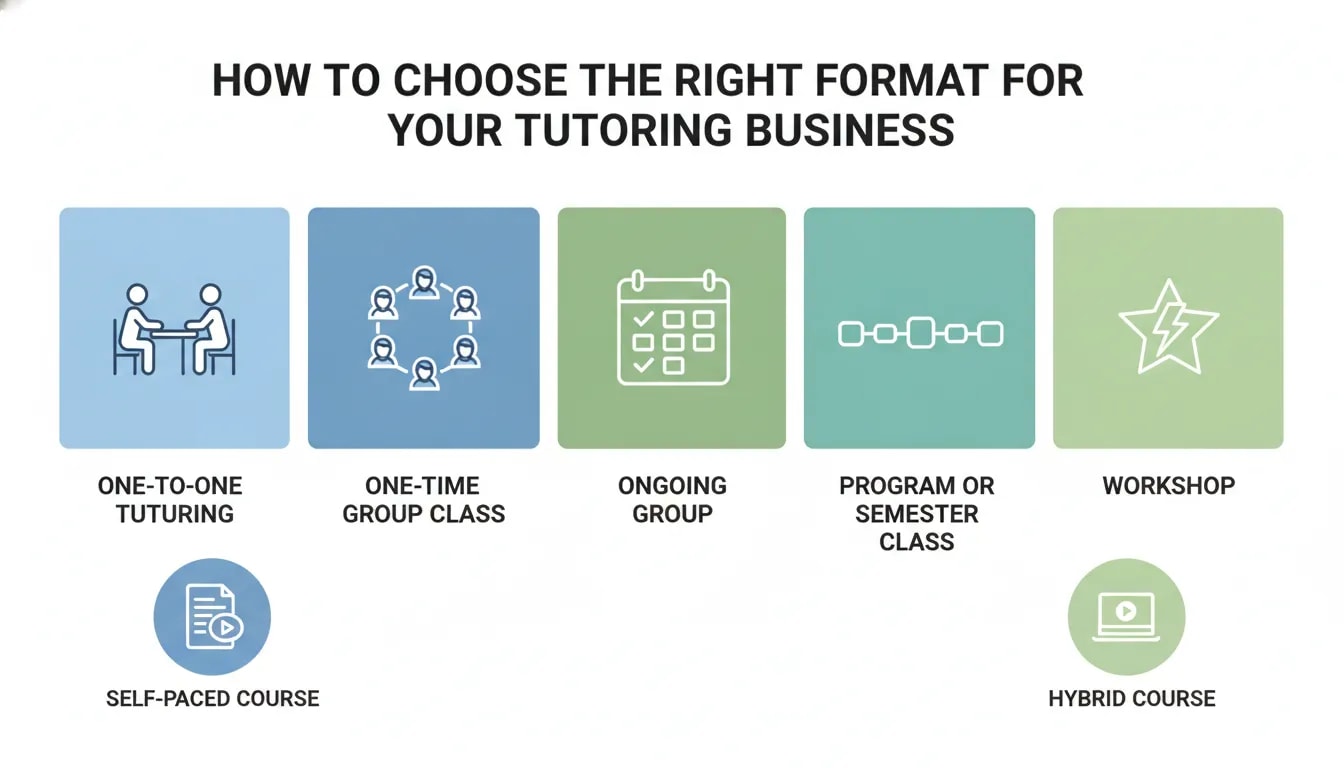
There is no single best format for every tutor. The right choice depends on the topic, the students’ needs, and how much ongoing support the learning outcome requires.
| Format | Best suited to | Key feature |
|---|---|---|
| One-to-one tutoring | Highly individualized needs | Personalized instruction and support |
| One-time group class | A single, focused topic | Short live teaching experience |
| Ongoing group | Skills that improve through regular practice | Recurring live instruction |
| Program or semester class | A defined learning progression | Structured sequence of lessons |
| Workshop | An immediate, practical need | Focused short-format outcome |
| Self-paced course | Repeatable, independent learning | Flexible access to prepared materials |
| Hybrid course | Independent learning with live guidance | Self-paced content plus live support |
A sensible starting point is to identify the lessons you teach most frequently. If several students repeatedly need help with the same skill, that topic may be a strong candidate for a group class, workshop, or course.
A Simple Plan for Launching a New Offer This School Year
- Identify a recurring student need. Look for topics, questions, or skills that come up repeatedly in your tutoring work.
- Select one delivery format. Start with a one-time group or workshop if you want to test demand before building a longer program.
- Define one clear outcome. Students should understand what they will learn or be able to do by the end.
- Set the schedule and scope. Decide whether the offer is a single session, recurring group, term program, or independent course.
- Create only the materials needed for the first launch. Avoid building an overly broad course before confirming that the topic fits your students.
- Review and refine. Use what you learn from the first class to improve the format, pacing, materials, and future offers.
Common Mistakes When Trying to Scale Tutoring Income
Trying to serve every learner in one class
A group becomes harder to teach effectively when students have very different skill levels or goals. Define the intended age range, subject focus, and starting level before opening enrollment.
Making the offer too broad
“Help with school” is not as clear as a focused class on a specific academic skill. A narrower promise makes it easier for the right students to recognize the value of the offer.
Building a large course before testing the idea
A short workshop or one-time group can help validate a topic before a tutor invests time in a longer semester program or self-paced course.
Assuming self-paced means no learner support is needed
Independent materials may suit some topics and students, but others need live explanation, feedback, and accountability. A hybrid format can address this gap.
Replacing private tutoring when it still fits the learner
Scaling should add options, not force every student into a group or course. One-to-one tutoring remains the right format for learners who need individualized attention.
Make the Most of the Back-to-School Opportunity
August and September are useful planning months for tutors who want to expand their offers. Start by choosing one recurring problem students face at the beginning of the academic year, then match it to a format that can help more than one learner.
A focused group class, workshop, structured program, self-paced course, or hybrid model can create new opportunities without abandoning the strengths of private tutoring. The goal is not simply to fill more time. It is to build teaching options that are clear, useful, and sustainable. And even more importantly, make it so that it pays off not only in income, but in saved admin time, stress managing groups and courses, and still being able to focus focusing on what you do best – teach, with an all-inclusive tool like SuperTeacher. Switch and scale from tutoring one and one, through offering groups – to selling digital products and courses – there is no better time than now. 🚀
Frequently Asked Questions
What is the easiest way for a tutor to move beyond one-to-one teaching?
A focused one-time group class or workshop is often a practical starting point. It allows a tutor to teach a recurring topic to several students while testing interest before creating a longer program.
What should a tutor teach in a group class?
Choose a skill or topic that multiple students commonly need, such as a subject refresher, study skills, reading, writing, or foundational math. Keep the group focused on a clear outcome.
Can tutors offer both private lessons and group programs?
Yes. Private tutoring can remain available for learners who need individualized support, while groups, workshops, and courses create additional options for students with shared learning goals.
What is the difference between a self-paced course and a hybrid course?
A self-paced course is completed independently using prepared learning materials. A hybrid course adds live teaching sessions, allowing students to receive explanations, practice, and support alongside independent work.
Leave a Reply