
If you have a few weeks before the new school year begins, you do not need to build a polished tutoring company from scratch. You need enough clarity and momentum to enter September with a defined offer, real conversations with parents, and ideally your first enrolment.
The most effective use of this time is not designing a logo, building a website, or creating months of worksheets. It is validating that parents want the specific result you can help students achieve.
What You’ll Learn
- Start with a narrow tutoring niche and an outcome parents can clearly understand.
- Use simple content and personal connections to create early parent conversations.
- Prioritize enrolments over websites, extensive curriculum, and polished branding.
- Offer a defined September programme for one student or a compatible small group.
Table of Contents
- What to Build Before Starting an Online Tutoring Business
- Why Many Teachers Get Stuck Before They Start
- Consider Group Tutoring From the Start
- What Not to Spend Your Summer Doing
- A Simple Online Tutoring Business Checklist
- Build Momentum, Not Perfection
What to Build Before Starting an Online Tutoring Business
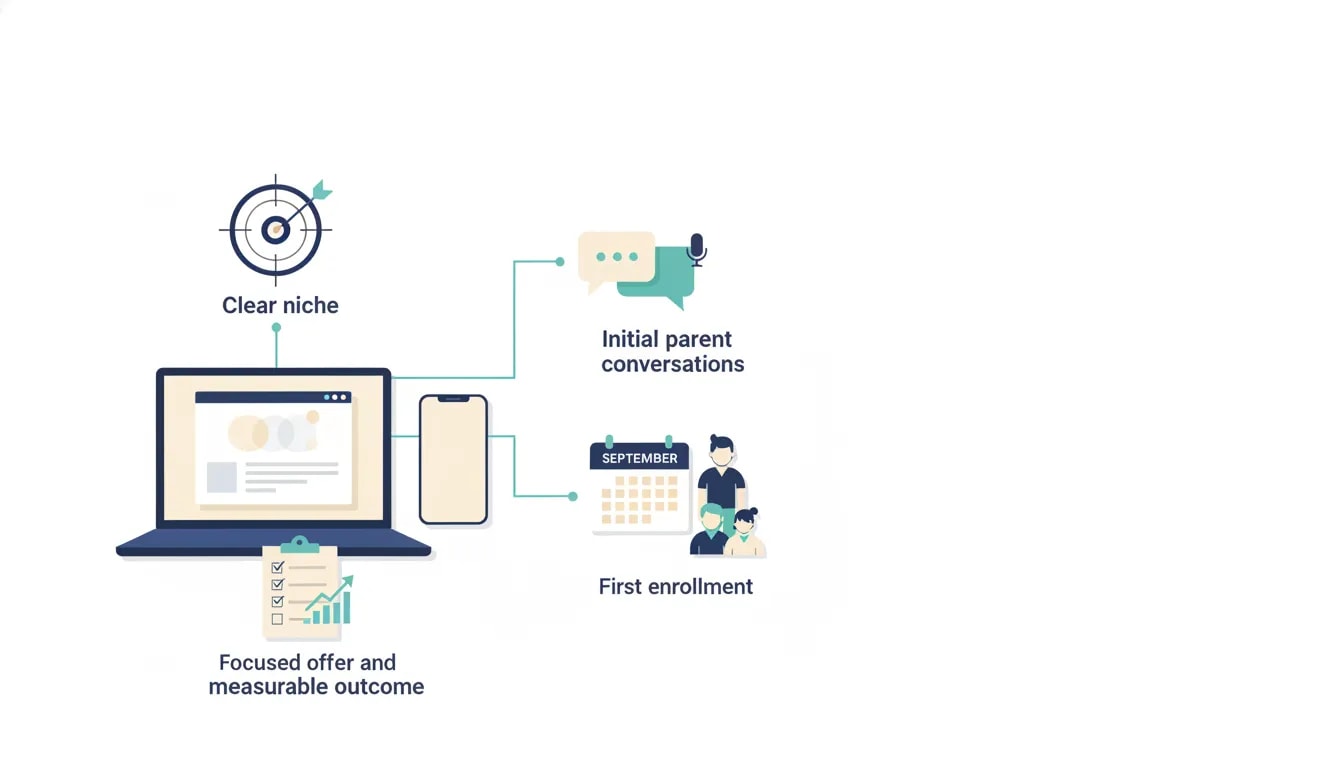
Your goal for the first 30 days is to create a foundation for a tutoring business, not to replace your teaching salary immediately. Focus on four practical outcomes:
- A clear niche: the subject, age group, and type of student you serve.
- A focused offer: a measurable academic outcome students and parents care about.
- Initial parent conversations: opportunities to understand needs and explain your service.
- Your first enrollment: one student or a small group with a September start date.
These early wins matter because they replace uncertainty with evidence. You will know who you help, what to say about your tutoring, and whether people are willing to pay for the support.
Why Many Teachers Get Stuck Before They Start
It is easy to confuse preparation with progress. Creating lessons, resources, curriculum documents, and a website can feel productive, but those activities do not necessarily lead to your first tutoring client.
Before you have students, prioritize actions that create demand: defining an offer, becoming visible, starting conversations, and enrolling families.
Your early students are usually looking for capable, reliable support and a clear plan to help their child move forward. You can teach live and refine your materials as you learn more about their needs. There is little value in creating extensive resources for students who have not yet enrolled.
Choose a Niche and Define Your Outcome
Start with one subject you can confidently teach. Then narrow it to the students who are under the greatest pressure to improve.
Pressure tends to create demand for tutoring. Common examples include students who are behind in a key skill, approaching an important exam, or struggling with a specific assessment standard.
Instead of positioning yourself broadly as a tutor for every student in a subject, identify a more defined group. For example:
- Third-grade students who need to improve reading skills
- Year 10 GCSE maths students currently working below their target grade
- Students who need stronger exam technique or revision habits
Next, define the result your service is designed to help them pursue. A useful offer describes a tangible goal rather than simply listing the subject you teach.
For instance, “GCSE maths tutoring” is broad. A clearer offer could focus on helping Year 10 students work towards moving from a grade 4 to a grade 7 over a 12-week period.
Turn your niche and outcome into a simple positioning statement:
I help [specific students] achieve [specific academic outcome] in [timeframe].
This is your promise. It gives parents a quick way to understand who you serve, what you focus on, and why your tutoring is relevant to their child.
Become Visible to the Right Parents
Once your offer is clear, make it visible. You do not need elaborate marketing campaigns at this stage. Start by publishing simple, useful content on the social platforms where your existing contacts can find you.
Your content should show that you understand the problems your ideal students face. If you help students improve in GCSE maths, possible topics include:
- Common gaps that hold students back in maths
- Why exam technique affects results
- Study habits that make revision more effective
- The areas students should prioritize before an exam
- Examples of student challenges you have helped address
You can use short written posts or straightforward talking-head content. The format matters less than clarity and consistency.
Share the important “what” and “why” behind improvement without trying to deliver an entire tutoring programme for free. The purpose is to demonstrate expertise and give parents a reason to ask about the support you provide.
Use Past Student Progress Carefully
If you have taught students before, their progress can help explain your approach. Describe the starting challenge, the focus of the support, and the improvement achieved.
For example, you might discuss how a student struggled with revision structure, then improved by concentrating on specific areas and practicing better exam habits. Keep the focus on the learning journey and the intervention that helped.
This type of content helps potential parents understand that your tutoring is outcome-focused rather than generic. It also gives your social profiles useful context before you begin more active outreach or paid advertising later.

Start Conversations With Your Existing Network
Your first leads do not require a website. Begin with people who already know you or who are connected to people who do. This is often the easiest place to build early trust.
Review your existing contacts across platforms such as Facebook, Instagram, LinkedIn, your email contacts, and your phone contacts. Reach out naturally, ask how their summer is going, and explain the student group you are preparing to support.
Then ask a direct referral question:
Do you know a parent or student who could benefit from this kind of support?
Do not expect every person to be interested or to know the right family. The point is to create enough conversations for referrals and opportunities to emerge. A few relevant introductions are more valuable than spending hours refining a website that no prospective parent has seen.
Enroll Your First Student or Small Group
When a parent expresses interest, keep the enrollment conversation simple. Start by learning about the student rather than launching into a detailed sales pitch.
- What is the student’s main struggle?
- What academic goal does the family have?
- What has the student already tried?
- What kind of support would make the biggest difference this term?
Then explain how your tutoring will work, the result you are focused on, and the planned September start date.
You can offer a 12-week programme aligned with the first school term, particularly when that timeframe fits the student’s goal. If a family is not ready to make that commitment, a first 30-day period can provide a lower-commitment starting point.
If you are working with your first students and want to build case studies, you may choose to offer an introductory case-study rate. Alternatively, you can charge upfront if the family is ready to enroll. The key is to set clear expectations and secure a real commitment rather than leaving the conversation vague.
Consider Group Tutoring From the Start
If you serve the same type of student with the same academic objective, group tutoring may be a practical option. Rather than teaching every learner individually, you can bring compatible students together for shared support.
For example, students preparing for the same exam level or working toward similar grade improvement goals may be suitable for one group. This approach can help you begin with more than one student while keeping your offer focused.
Grouping only works when students have sufficiently similar needs. Avoid combining students with unrelated goals simply to fill a session. Your offer should still be clear and relevant to everyone enrolled.
What Not to Spend Your Summer Doing
When time is limited, avoid making these tasks your main priority:
- Building a full website before speaking to prospective parents
- Creating an extensive curriculum before enrolling students
- Producing large libraries of worksheets and resources
- Perfecting branding, logos, or design details
- Waiting until every part of the business feels complete
These items may become useful later, but they should follow early validation. Your first priority is to find out whether your niche, offer, and message lead to conversations and enrollments.
A Simple Online Tutoring Business Checklist
Before school starts, aim to complete this checklist:
- Choose one subject and one specific student group.
- Identify the academic pressure or problem that creates demand for help.
- Define a measurable outcome your tutoring is designed to support.
- Write a one-sentence promise that explains your offer.
- Publish several helpful posts connected to student problems and outcomes.
- Share relevant examples of prior student progress where appropriate.
- Contact people in your existing network and ask for referrals.
- Hold conversations with interested parents.
- Set a September start date for your first student or group.
- Offer a clear programme length, payment arrangement, and next step.
Build Momentum, Not Perfection
Starting an online tutoring business before school begins is about gaining traction. A focused niche, a clear outcome, visible expertise, and a handful of parent conversations can put you in a far stronger position by September.
Do not wait for the perfect business model. Start with an offer that solves a defined student problem, speak to families who may need it, and improve your delivery as you gain experience and results.
Frequently Asked Questions About Starting an Online Tutoring Business
Do you need a website to start online tutoring?
No. You can begin by defining your offer, posting useful content on existing social profiles, and speaking with people already in your network. Once you’re ready to enroll your student use a proven sales funnel with an educators page such as SuperTeacher.
How do you find your first tutoring clients?
Start with your existing contacts, share what type of student you help, and ask whether they know a parent who could benefit from your service.
What should an online tutoring offer include?
A strong offer identifies the student, the subject or problem, the academic outcome, and a timeframe for the support.
Should you offer individual or group tutoring first?
Either can work. A group may suit students with similar goals, while individual tutoring may be appropriate when a student needs more tailored support.
Leave a Reply