
If you teach independently, or you are getting ready to, one thing matters more than most teachers realize: your class offer.
Not your credentials alone. Not your tools. Not even your lesson length.
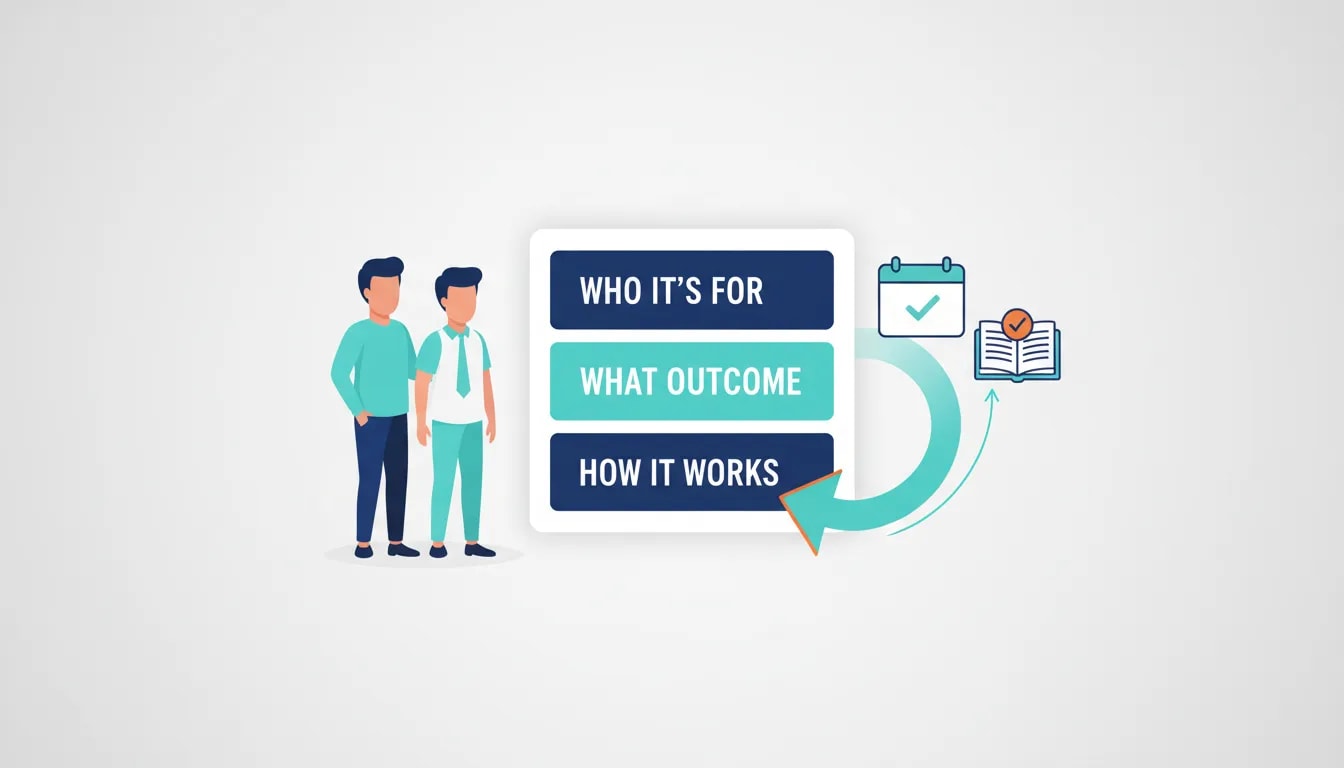
The real question is this: can a parent or student instantly understand what they are buying, who it is for, and why it matters?
Because people do not book what they do not understand.
That single idea explains why so many excellent teachers struggle to attract new students, even when they are highly qualified and genuinely great at what they do.
Most educators describe what they teach. But students do not buy what you teach. They buy what they get.
That shift changes everything.
Why most class offers do not convert
A lot of teachers, especially those coming from online companies or marketplaces, are used to offering classes like this:
- English lessons
- Math tutoring
- Coaching sessions
- 25-minute classes
- 15-class package
That may work if you already have regular students who simply need a place to pay and book. But if you are trying to attract new students, this kind of offer is too vague.
It does not answer the questions people are silently asking when they land on your page:
- Is this for me?
- What exactly will I get?
- Why should I care?
If your offer does not answer those questions quickly, people hesitate. And hesitation usually means no booking.
The biggest mistakes teachers make when designing a class offer
1. The offer is too broad
“English lessons” sounds simple, but it is too general to trigger a decision.
Imagine a parent searching online and seeing 20 teachers all saying some version of:
- I teach ESL
- I teach English to non-native speakers
- I teach English to children
Nothing stands out. Nothing feels personal. Nothing signals a clear result.
2. There is no clear outcome
People rarely want “sessions.” They want progress.
They want speaking confidence, reading support, test prep, curriculum completion, or help with a very specific challenge.
If all you are selling is time, students compare you by price. If you sell an outcome, they compare you by value.
3. You are trying to speak to everyone
An offer that targets everyone usually connects with no one.
“I teach ESL to students” is not enough. What kind of students? What age? What level? What problem are they trying to solve?
When your offer is broad, no one feels like it was made for them.
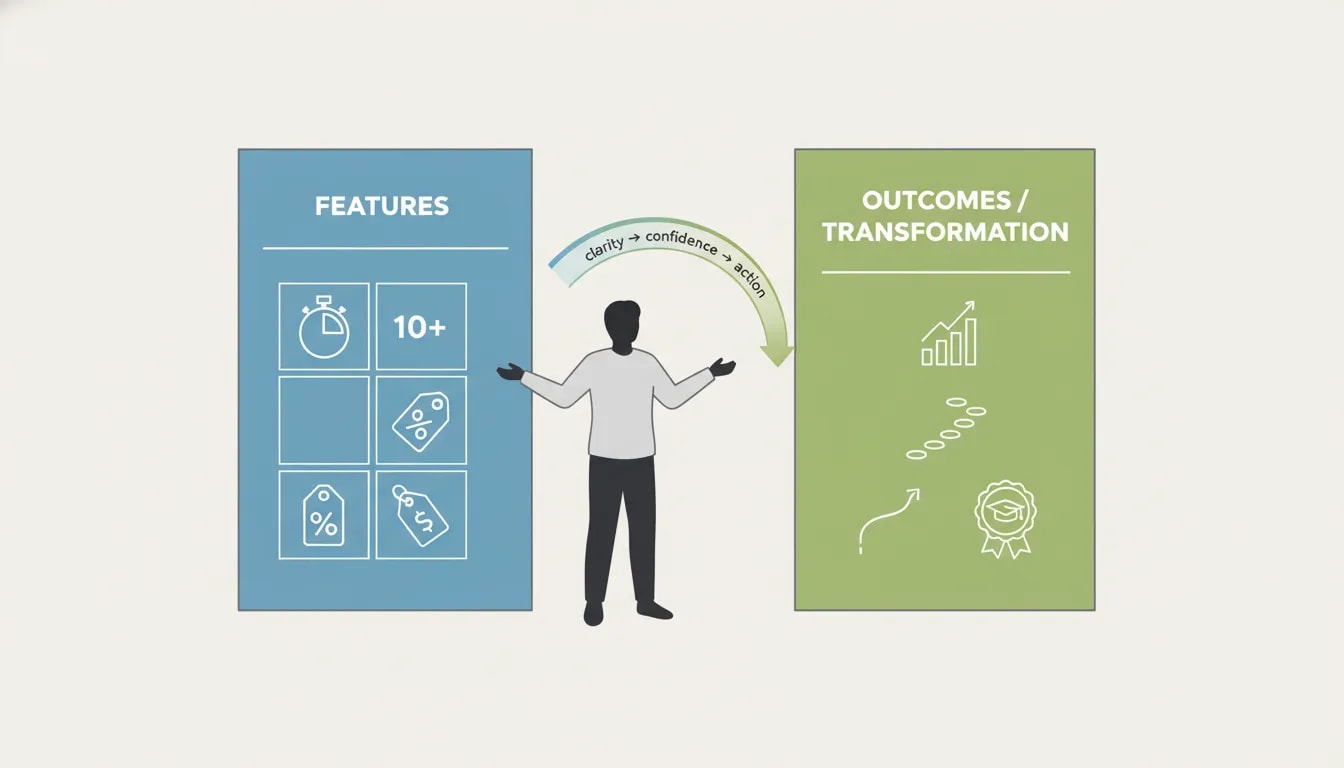
4. You focus on features instead of transformation
This is a common habit teachers pick up from companies and marketplaces.
Those systems often train teachers to think in terms of:
- lesson length
- number of classes
- years of experience
- package size
- discount percentage
But those are features, not outcomes.
Features matter later. First, the student needs to understand the value.
What a strong class offer actually looks like
A good offer is clear, specific, and outcome-oriented.
One simple way to build it is this sentence:
I help [who] achieve [what] through [how].
That framework forces clarity.
For example, instead of offering:
- 45 class credits
- 15% off 25-minute classes
You might offer something like:
B1 Speaking Course for Young Learners Ages 9 to 12
Immediately, that says more.
- It tells the parent who it is for
- It tells them the level
- It tells them the focus area
- It feels like a path, not a random bundle of lessons
Even if the price is identical, the second offer is easier to understand and much easier to buy.
Sell programs, not just class credits
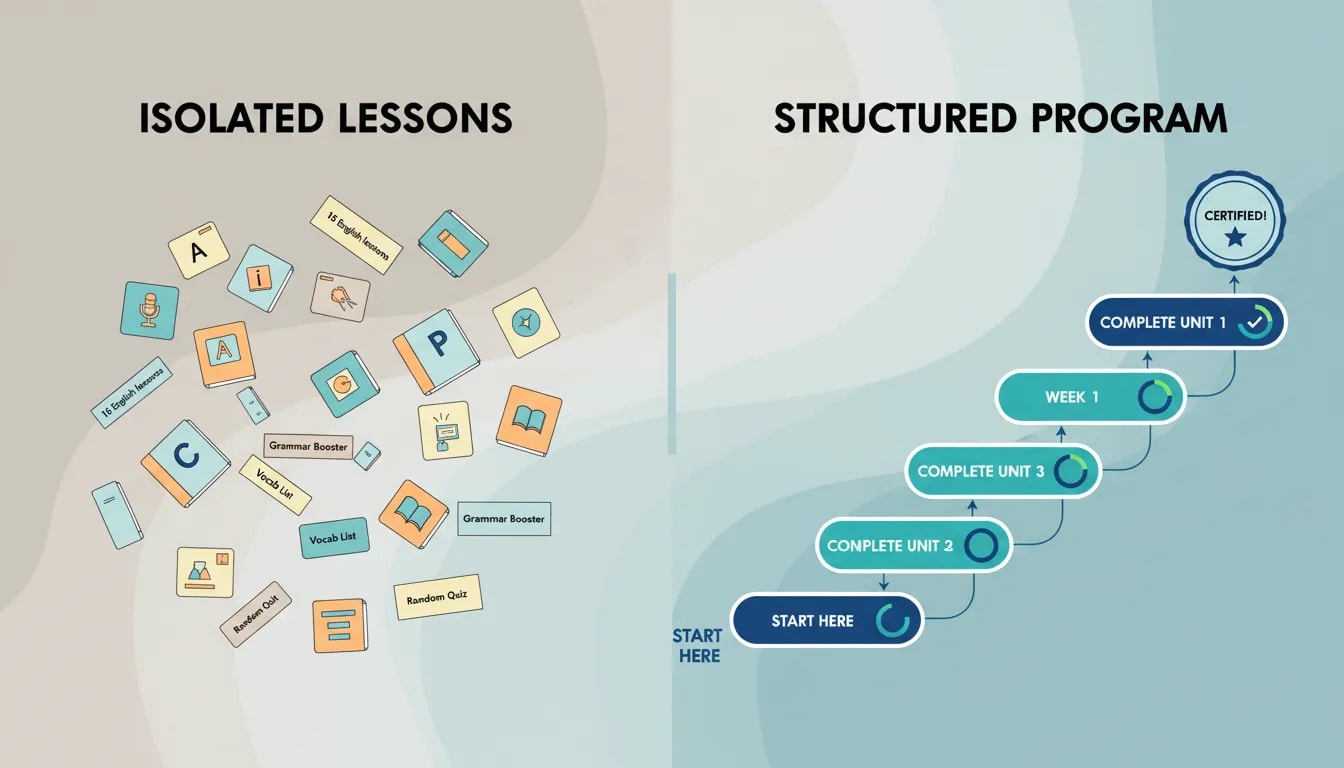
This is the core shift: stop selling isolated lessons and start selling structured programs.
A program gives your teaching a shape. It implies:
- a clear goal
- a beginning and an end
- measurable progress
- a reason to continue to the next step
Compare these two examples:
- 15 English lessons in a package
- Complete Unit 1 of a beginner English curriculum
Or these:
- Conversation classes
- Build speaking confidence in a 4-week conversation program
The second version in each pair is stronger because it gives the student context and direction.
And there is another benefit: it makes renewals more natural.
If a student finishes Unit 1, the next offer is obvious. If they complete a speaking program, they can move into the next level or a related skill area. You are not constantly reselling from zero. You are guiding them along a structured journey.
Use the SMART framework to shape your offer
A useful way to test your offer is to run it through a SMART lens.
- Specific – Is the offer clearly defined?
- Measurable – Can the student see what progress or milestone is included?
- Attainable – Does the goal feel realistic?
- Relevant – Does it match what the student actually needs?
- Time-based – Is there a clear timeframe or endpoint?
For example:
Build speaking confidence in a 4-week conversation program
This works because it is:
- specific: speaking confidence
- measurable: a defined program
- attainable: realistic for a short timeframe
- relevant: useful for learners who want practical speaking help
- time-based: 4 weeks
The more clearly your offer communicates these elements, the more confidence the buyer feels.
Why clear offers sell better
When your class offer is structured well, several good things happen at once.
- People ask fewer questions
- They hesitate less
- They understand the value faster
- They feel more confident making a decision
Instead of this path:
confusion → delay → no booking
You create this one:
clarity → confidence → action
That is what a well-designed class offer does.
Find your niche without overcomplicating it
You do not need to overthink niche selection, but you do need some focus.
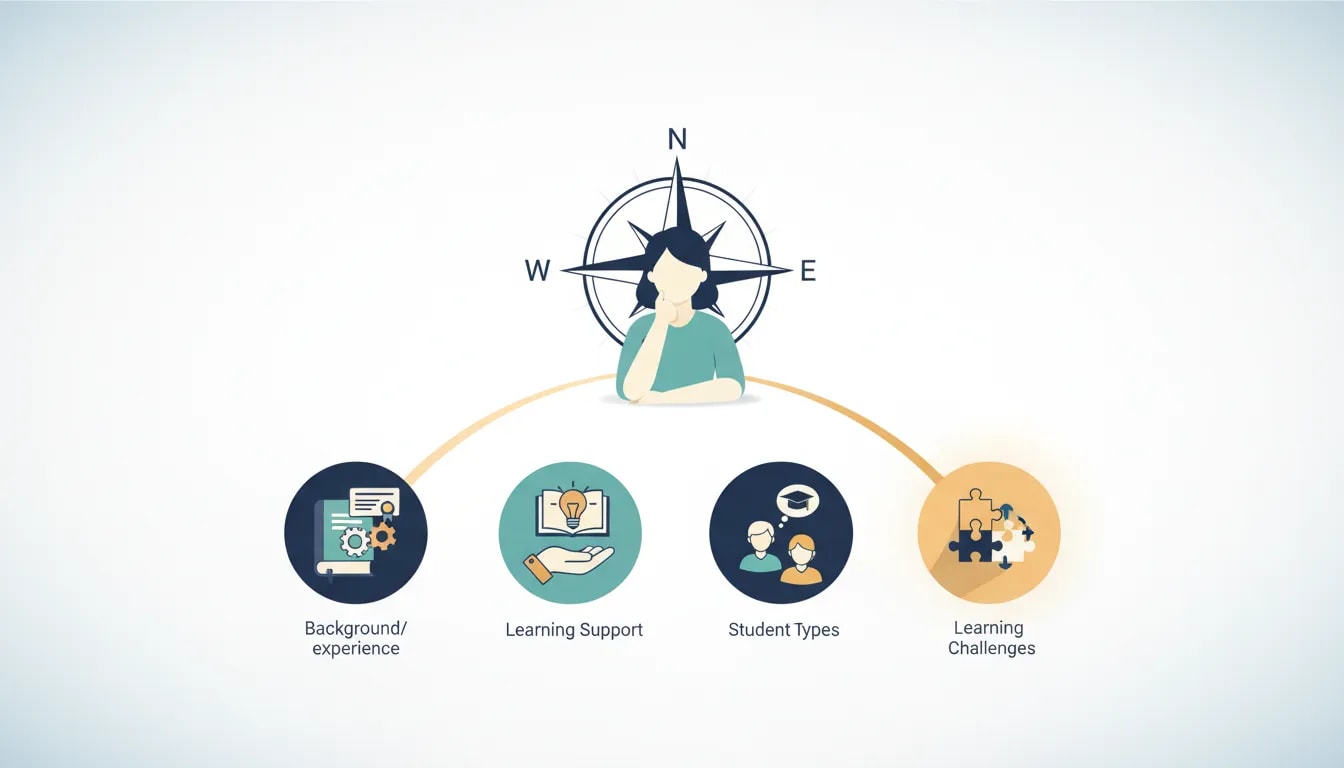
Start with what is already natural for you:
- Your background
- Your experience
- The kinds of students you work best with
- The learning challenges you understand deeply
For example, if you are a special educator, that may eventually become a strong niche inside ESL or literacy support. If you have strong experience with test prep, that can become a clear offer. If you are great with reading support, confidence building, or beginner speaking, that can become the center of your first offer.
You do not need ten offers to begin. One clear offer is better than ten fuzzy ones.
Different ways to package your teaching
One-on-one classes are only one format. Independent educators have more options than many realize.
One-on-one programs
These can be:
- curriculum-based
- level-based
- skill-based
- topic-based
- goal-oriented
Examples:
- Complete Unit 1 of a beginner curriculum
- B1 speaking course for ages 9 to 12
- Guided conversation sessions for beginner adults
Group classes
Group teaching opens even more possibilities.
You can offer:
- one-time themed classes
- seasonal workshops
- book clubs
- ongoing support groups
- test prep groups
- curriculum-based small groups
Some example formats that work well include things like:
- Science Club
- Reading Corner
- Holiday workshops
- Ongoing school support groups
- Homework practice groups
Self-paced courses and resource access
If you create your own materials, do not overlook the value of what you already have.
You might be sitting on:
- homework packets
- games
- review sheets
- lesson extensions
- curriculum extras
Those can become:
- a resource library
- a self-paced mini course
- a membership add-on
- a premium tier for current students
The key is not to build everything at once. Test whether people actually want it first.
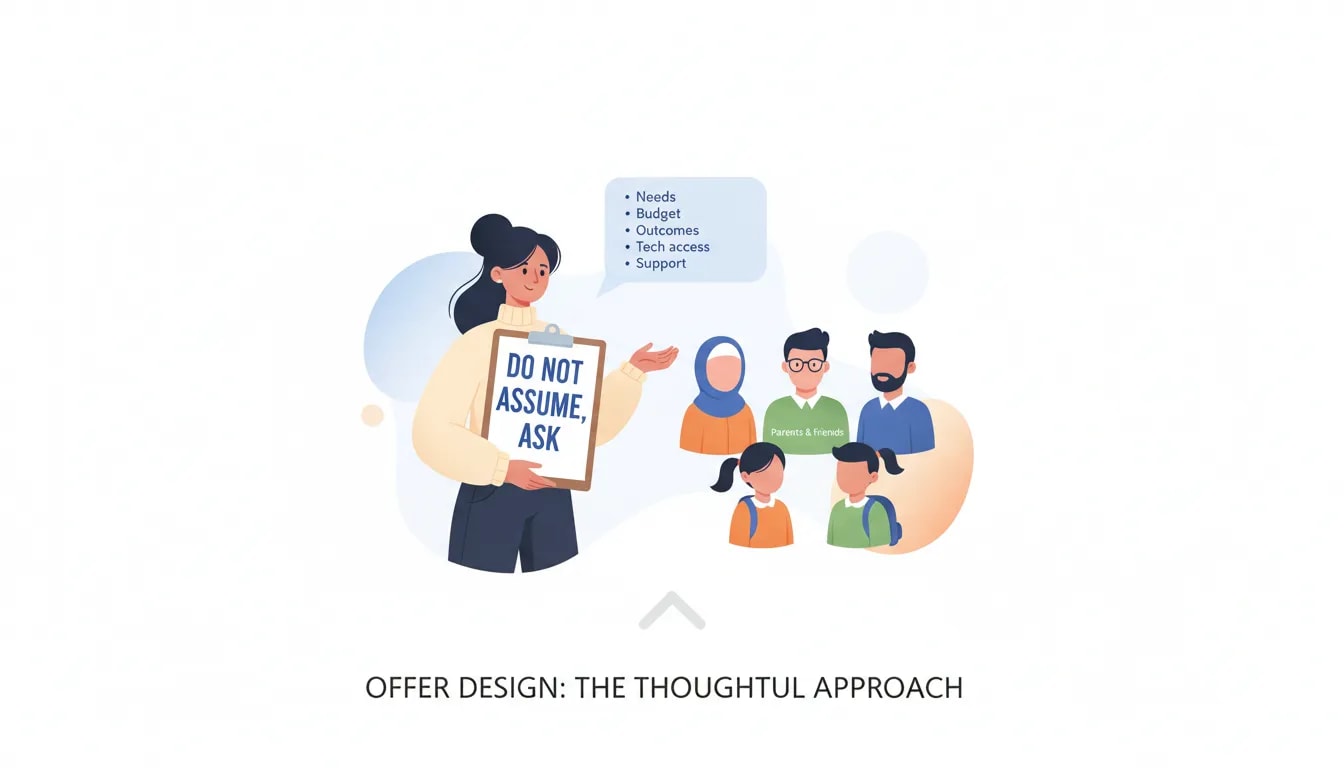
Do not assume. Ask.
One of the best principles for designing offers is simple: do not assume, ask.
Ask:
- your current students
- past students
- parents
- friends and family in your network
- other teachers
- yourself, honestly
Find out:
- what students actually need
- what they are used to paying
- what outcomes they care about
- what technology they can access
- what support they value beyond class time
This matters especially if you teach internationally. A market where every tool works is very different from a market with tech limitations, restricted platforms, or different payment habits.
The better you understand your students, the better your offer becomes.
How to respond when someone asks, “How much?”
This is such a common moment, and many teachers lose the sale right here.
Someone messages you and says:
“Hello teacher, how much?”
The instinct is to answer with a number. But that often turns the conversation into a price comparison game.
A better move is to answer with a question.
Try something like:
- What are you looking for support with?
- What is your child currently struggling with?
- What learning goal do you have in mind?
- Why did you decide to reach out now?
That changes the whole tone of the conversation.
Now you are not just quoting a price. You are diagnosing a need. You are showing genuine interest. And once that happens, the price discussion becomes much easier because the value is now tied to a real problem.
Build your offer in tiers
A strong teaching business usually needs more than one price point.
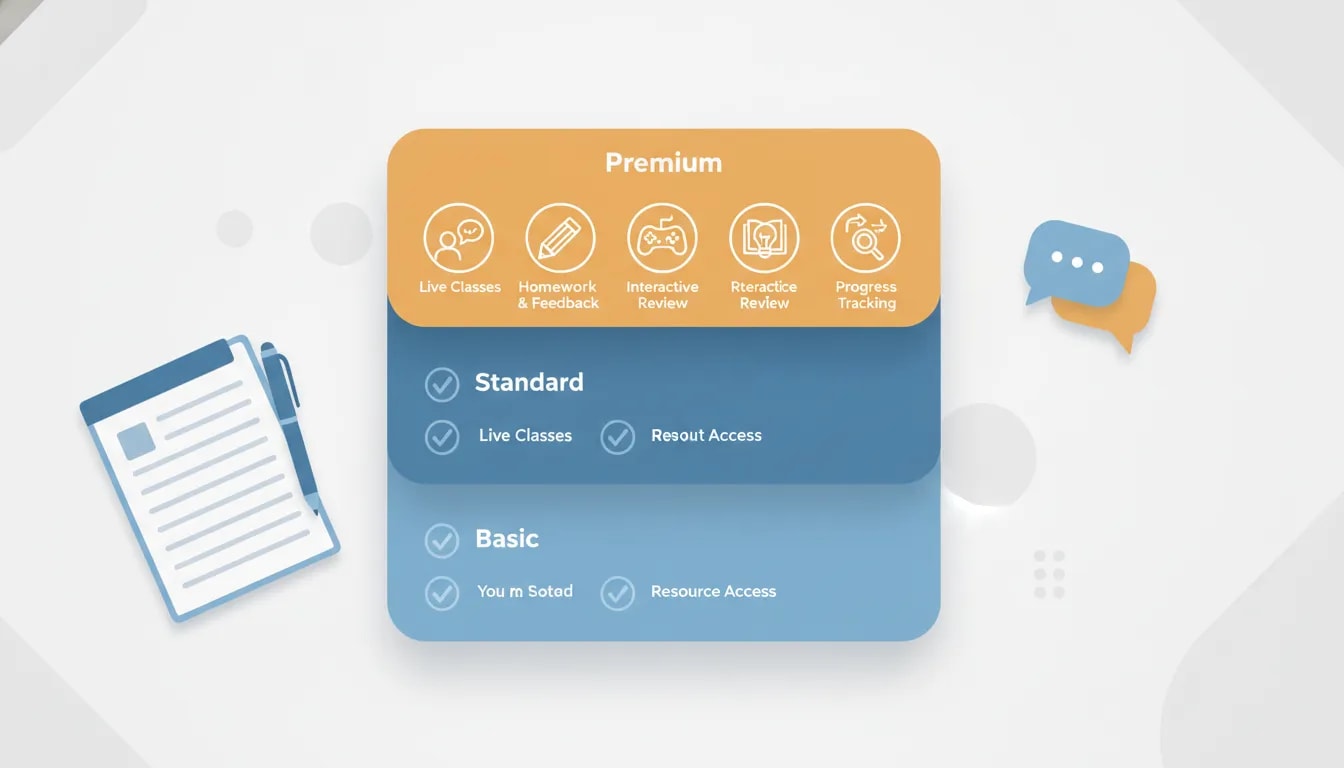
That does not mean making things complicated. It means creating sensible tiers so students can choose the level of support that fits them.
For example:
Basic tier
- live classes only
- no homework
- no feedback extras
- no extra resources
Standard tier
- live classes
- homework after each class
- feedback within a set timeframe
Premium tier
- live classes
- homework and feedback
- games or interactive review
- resource access
- extra support or progress tracking
This lets you serve different budgets without underselling yourself.
Have a Plan B when students say your price is too high
Flexibility matters, but it should be structured.
If someone says your private class is too expensive, that does not automatically mean they are not a good fit. Sometimes they simply need a different format.
One clever strategy is to offer a group option.
For example, if your private class is priced at a level that a family cannot afford, you can invite them to bring a friend and split the cost. That way:
- the family pays less
- the student still gets access
- you still earn your intended rate
If more students join after that, those additional seats can even increase your hourly income.
That approach works especially well when one parent is willing to coordinate the group.
Other Plan B options might include:
- a smaller program
- a lower-touch offer
- resource-only access
- a themed workshop instead of private lessons
The point is not to discount randomly. The point is to have alternative ways for people to enter your world.
Price your classes properly
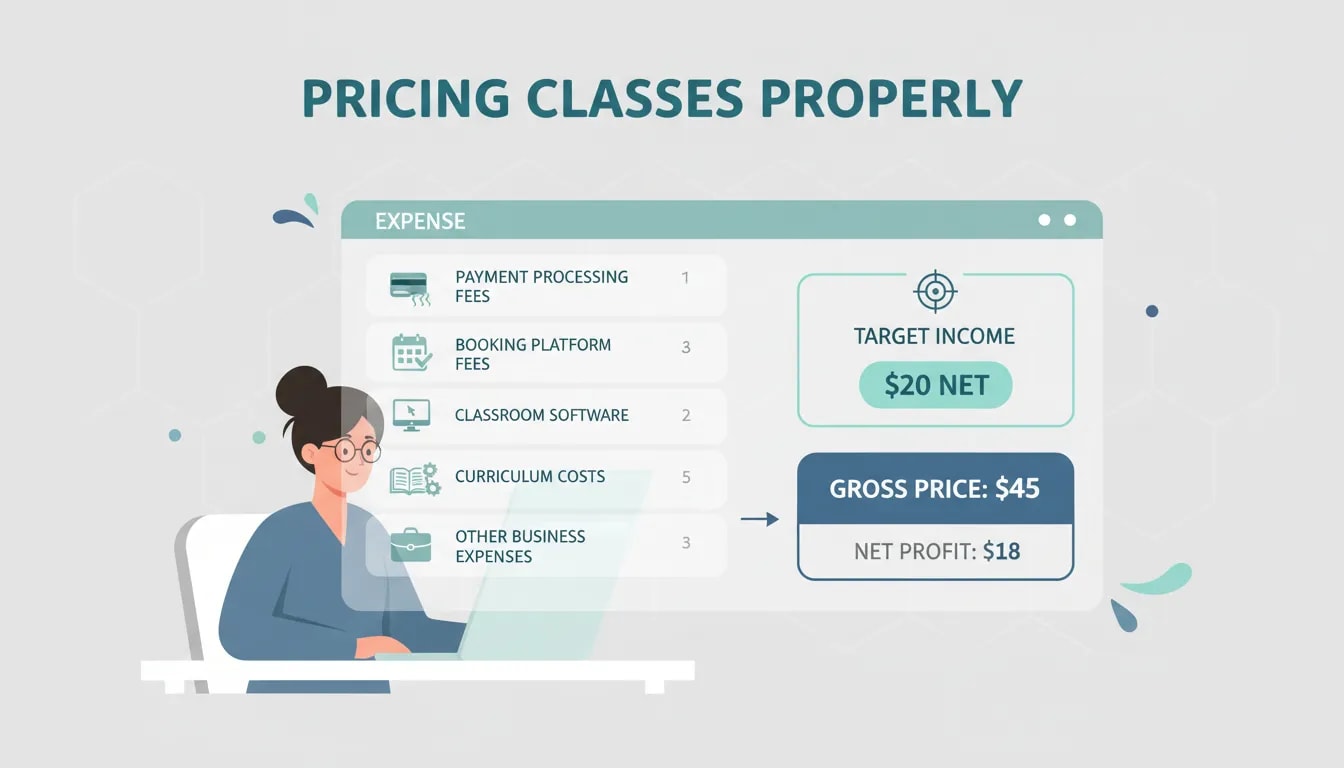
Many teachers decide what they want to earn per class and stop there. But your actual price needs to account for your real costs.
That includes things like:
- payment processing fees
- booking platform fees
- classroom software
- curriculum costs
- other business expenses
If your goal is to earn $20 per class, you cannot simply charge $20 and assume it all lands in your pocket.
You need to calculate the true student price that leaves you with your target income after expenses.
Once you know your real single-class rate, that becomes your top price. From there, you can build packages, subscriptions, or program discounts in a way that still protects your business.
What to offer first if you are just starting
If you are new to independent teaching, keep it simple.
Start with:
- one clear audience
- one clear outcome
- one strong offer
That is enough to get traction.
You do not need years of testimonials before you can create a meaningful offer. You need clarity.
If you can say, with confidence:
I help beginners start speaking basic English through guided conversation sessions.
that is already a real offer.
You are not promising perfection. You are offering a structured path.
What if you want to work with multiple audiences?
You can. But do not try to talk to everyone all at once.
It is usually more effective to begin with one clear message and one clear offer. Once that gains traction, you can expand into separate offers for different audiences.
The issue is not whether you are capable of teaching multiple groups. The issue is whether each group can clearly recognize themselves in what you are offering.
What if you already have an offer, but it is not converting?
That does not mean the idea is bad. It usually means one of three things is missing:
- clarity
- positioning
- structure
Sometimes the problem is just the wording.
Sometimes the offer sounds too generic.
Sometimes there is no obvious next step.
Before throwing the whole thing away, refine it. Make the audience clearer. Make the outcome more concrete. Give it a beginning, an end, and a reason to care.
Should you offer discounts or free trials?
They can work well, but only when they are used intentionally.
For example:
- a free trial for a warm referral
- a paid trial for brand new leads
- a coupon as a first-step incentive
- a discount tied to a bigger commitment
What you want to avoid is random discounting that lowers your perceived value.
Students do not need lower prices as much as they need a clear reason to start.
Do not build your whole business on one platform or one source of students
This advice comes up again and again for a reason: diversify while you can.
If you are still teaching for a company or marketplace, do not rush to quit before you have built some stability independently.
It is much easier to create offers, test your marketing, and grow your student base when you are not under immediate financial pressure.
Build while you still have stability.
That gives you room to make better business decisions instead of desperate ones.
Ways to make your offer more visible and easier to buy
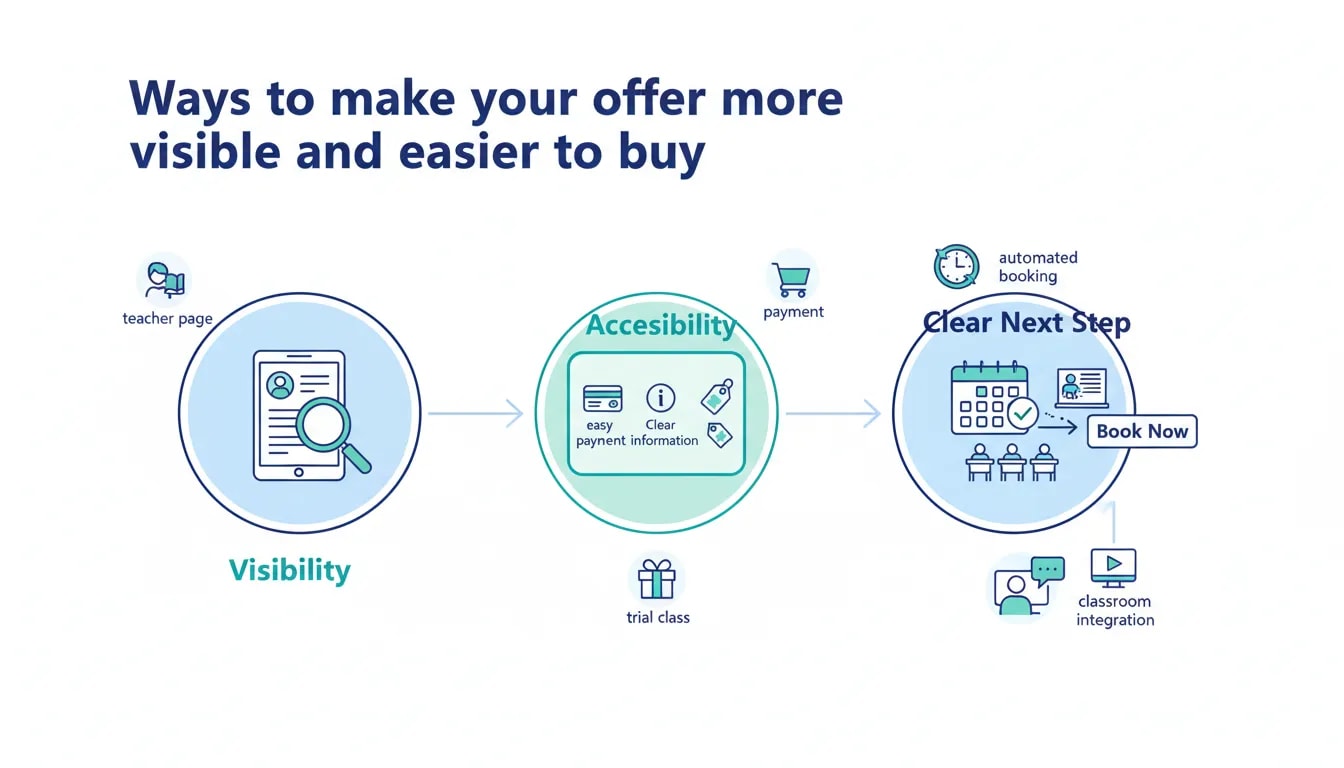
A strong class offer is only one piece of the puzzle. For it to work, it also needs:
- visibility
- accessibility
- a clear next step
That means students need to be able to:
- find the offer
- understand the offer
- pay for the offer
- book the class
- join the classroom easily
If you use a system like SuperTeacher, that can include things like:
- personal teacher pages
- global payment options
- support for one-on-one classes, group classes, and self-paced courses
- classroom integration
- subscriptions
- trial classes
- coupons
- automated booking and class management
- student portals
The simpler the experience is for the student, the more likely they are to move forward.
Examples of offer types worth considering
If you want a few ideas to work from, here are some strong directions:
Topic-based offers
- Reading club
- Science club
- Holiday-themed workshops
- Project-based sessions
Curriculum-based offers
- Unit 1 completion packages
- Full level programs
- Semester support
Skill-based offers
- Speaking confidence programs
- Reading support
- Test prep
- Homework help
Hybrid offers
- live classes plus self-paced resources
- live lessons plus homework and feedback
- class credits plus resource library access
The mindset shift that makes all of this easier
The biggest shift is this:
You are not just selling time slots. You are designing a learning experience.
When you think in programs instead of isolated classes, you naturally become clearer about:
- who you help
- what result you guide them toward
- how your offer is structured
- what comes next after the first purchase
That is what helps you stand out.
That is what reduces price comparisons.
And that is what makes your offer feel worth buying.
Final thought
If students are not booking, the problem is not always your teaching. Very often, it is simply that the offer is unclear.
Clear offers build trust. Structured offers create momentum. Outcome-based offers sell.
So before changing platforms, cutting prices, or doubting yourself, go back and look at what you are actually presenting.
Make it specific. Make it relevant. Make it easy to understand.
When people can clearly see the value, booking becomes a much more natural next step.
Sign up with SuperTeacher
Register for free, pick the right plan later
Leave a Reply