
Going independent can feel intimidating when you focus first on one question: Where will enough students come from? That question often leads to the wrong mindset. You may start imagining that you need hundreds of learners before independent teaching can work.
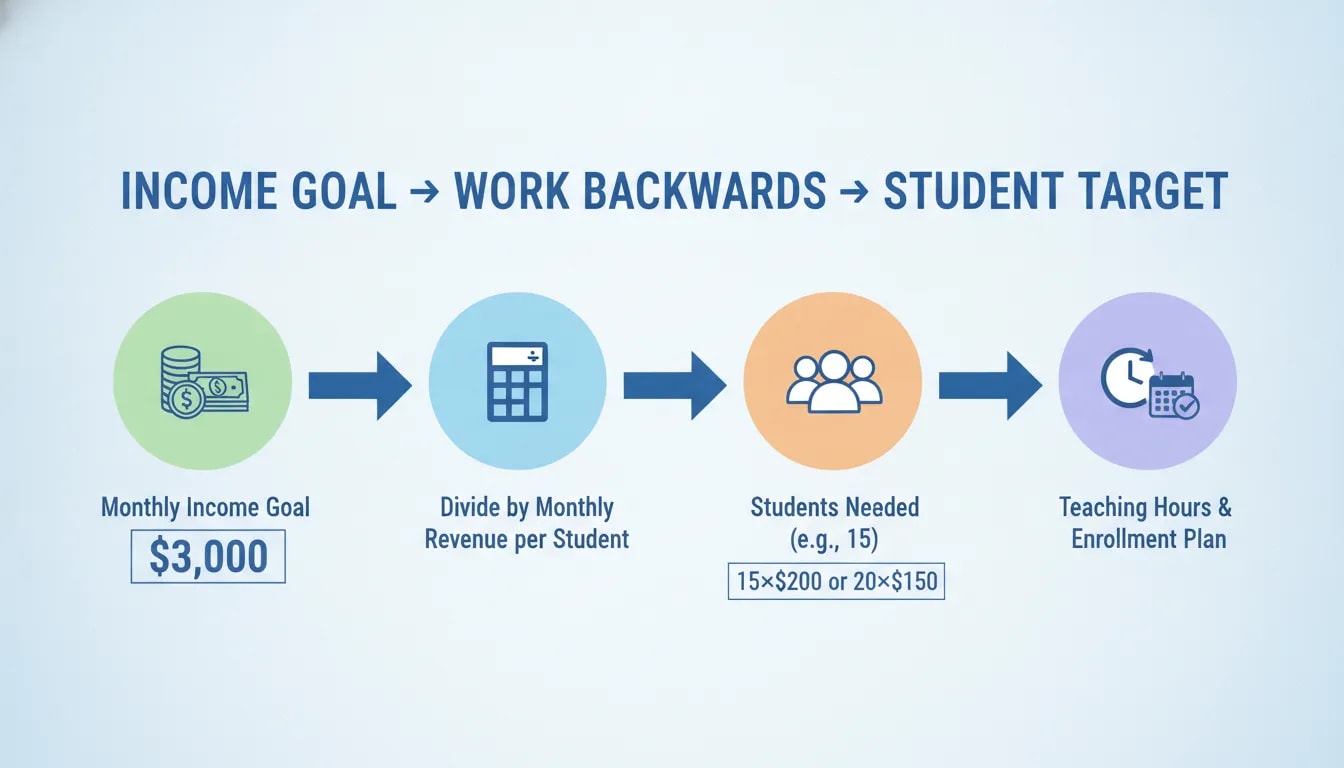
A more useful starting point is your desired monthly income. Once you know what you want to earn, you can work backwards to estimate the number of students, the monthly value of your offer, and the teaching hours required to reach that goal.
This turns a vague ambition into a practical plan. Instead of trying to attract “as many students as possible,” you can identify the smaller, more specific target your education business actually needs.
Start With Your Monthly Income Goal
Your income goal is the foundation of the calculation. Choose a monthly amount that gives you a clear target to plan around.
For example, suppose you want to earn $3,000 per month. That does not automatically mean you need a huge student roster. The number of students depends on what each student pays for your tutoring, classes, or ongoing support.
The key question becomes:
How many students do I need at my current or intended monthly price to reach my income target?
Use this basic formula:
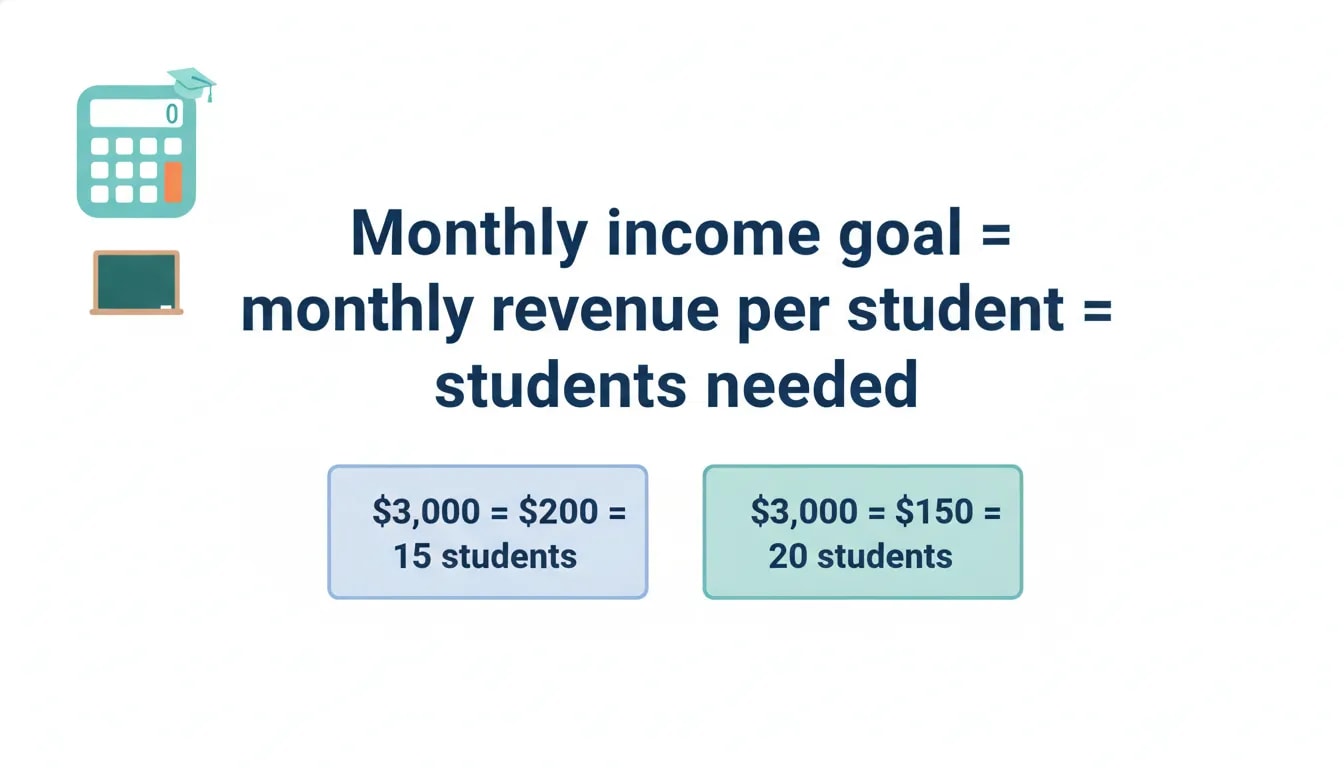
Monthly income goal ÷ monthly revenue per student = students needed
It is a simple equation, but it can change how you approach independent teaching. Your goal is no longer an abstract income figure. It becomes a student target you can understand and plan for.
Calculate How Many Students You Need
Using a $3,000 monthly income goal, here are two possible ways to reach the same target:
- 15 students paying $200 per month equals $3,000 per month.
- 20 students paying $150 per month also equals $3,000 per month.
Neither option is automatically better. The purpose of the calculation is not to tell you the one correct price or student count. It is to show that there are multiple paths to the income you want.
Your own numbers may be different based on the type of teaching you provide, the audience you serve, and the offer you create. What matters is that you can see the relationship between:
- Your income target
- Your monthly price per student
- Your required number of students
- Your available teaching hours
Once these numbers are visible, you can make choices deliberately instead of guessing.
Why You Do Not Need Hundreds of Students
Many tutors treat independence as a volume problem. They assume success requires building a massive audience or enrolling an overwhelming number of students. In reality, your required student count may be much more manageable when you begin with the income you want to earn.
If your monthly goal is $3,000 and your offer is worth $200 per student each month, your target is 15 students. That is a concrete business goal, not an unlimited search for more enrollments.
This distinction matters because it helps you focus your energy. You are not trying to become known by everyone. You are trying to build an offer that serves the right students and enroll enough of them to meet your financial goal.
A clear number also makes progress easier to measure. If your target is 15 students, each new enrollment represents a meaningful step toward a defined outcome.
Common Mistakes When Planning Your Tutor Income
Starting with a random student number
Choosing a number such as 50 or 100 students before doing the income math can make independence seem harder than it needs to be. Start with the monthly income goal, then calculate the student count that supports it.
Treating price and enrollment as separate decisions
Your monthly price directly affects the number of students you need. Review both numbers together so you can see the full picture.
Ignoring the hours behind the student count
A student target should work with your available teaching time. As you work backwards, consider whether your offer and schedule support the number of students required.
Making the goal too vague
“I want more students” is not a plan. “I need 15 students paying $200 per month to reach $3,000” gives you a measurable objective.
Assuming one income goal has only one solution
There can be several combinations of price and enrollment that reach the same monthly income. The right approach is the one that makes sense for your offer, your students, and your available time.
Use Your Student Target to Guide Marketing
When you know the number of students you need, marketing becomes more purposeful. You can focus on reaching the people most likely to benefit from your classes or tutoring, rather than trying to appeal to everyone.
Your income goal should shape your offer, your enrollment process, and your promotion strategy. A clear target also helps you evaluate progress. If you need 15 students, you can track your movement toward 15 instead of relying on a general feeling that you should be growing faster.
Practical promotion does not have to begin with a large audience. It begins with a clear offer, a specific student target, and a way for prospective clients to understand and book your services. For more ideas, see these strategies for marketing your education business.

The Bottom Line: Build Backwards, Not Bigger
You do not need to begin your independent tutoring journey by chasing an enormous number of students. Begin with the monthly income you want to earn.
Then work backwards:
- Set your monthly income goal.
- Decide the monthly value of your offer.
- Calculate how many students you need.
- Consider the hours required to serve them.
- Build a focused plan to enroll that number of students.
This approach replaces uncertainty with a concrete target. Your goal is not simply to find more students. Your goal is to find the right number of students for an offer and schedule that can support the independent teaching business you want to build.
Frequently Asked Questions
How do I calculate how many tutoring students I need?
Divide your monthly income goal by the monthly amount each student pays. For example, a $3,000 goal divided by $200 per student equals 15 students.
How much should an independent tutor charge per month?
Your monthly price should be considered alongside your income goal, the value of your offer, and the number of students you want to serve. Different prices create different enrollment targets.
Do independent tutors need a large number of students?
Not necessarily. The number you need depends on your income goal and the monthly revenue per student. Working backwards from your target can reveal a more manageable number.
Why should tutors consider teaching hours when setting an income goal?
Your student target needs to fit the time required to teach and support those students. Reviewing hours helps you choose an offer and enrollment goal that are realistic for your schedule.
Leave a Reply